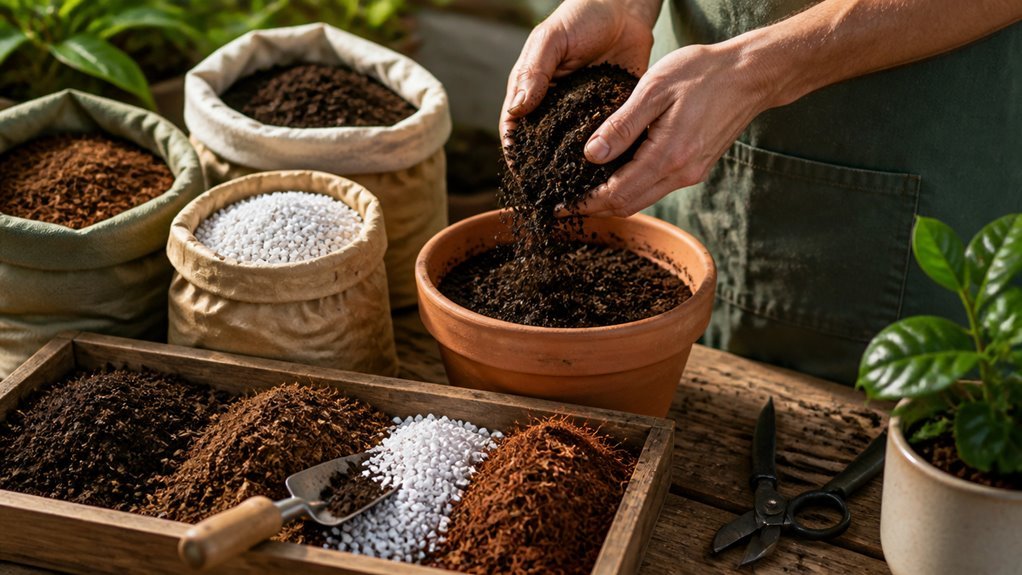
I mix potting soil using six gallons peat moss, four and a half gallons perlite, and six gallons compost. I add one part perlite for aeration and balance pH with lime to hit 6.0–7.0.
I include bone meal, rock phosphate, and kelp meal for nutrients. The ratios shift for seeds, succulents, or shrubs, and I store extra mix in sealed bins. You need the right blend for roots to do well.
Start With This All-Purpose Potting Soil Recipe
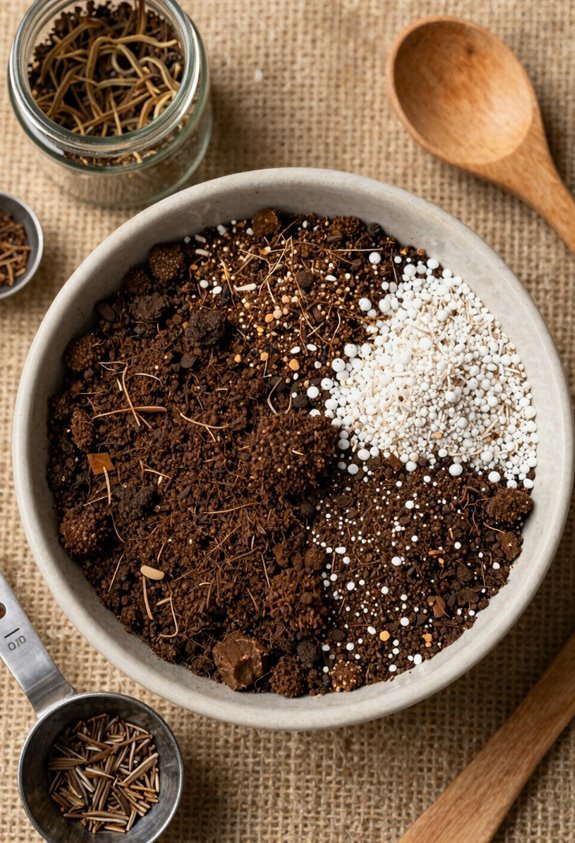
Why overthink your mix when a solid base does the job? I grab my all-purpose soil, and I’m ready.
A solid base does the job—grab your all-purpose soil and get growing.
Peat Moss and Perlite Base
Standard recipe: six gallons peat moss, four and a half gallons perlite, six gallons compost. I’ll add quarter-cup lime if I’m using peat moss. That lime fixes pH, pushes it toward neutral.
Drainage Check
Perlite handles drainage. No soggy roots, no rot. My potting mix stays workable, roots breathe.
Moisture Test
I mist until damp. Squeeze handful, couple drops fall. That’s it. Too wet kills seedlings.
Final pH Target
Six to seven covers most plants. Peat runs acidic; lime corrects that. I’ve got compost for nutrients, structure, life.
Build this base. You’ve joined the growers who know.
Choose Your Base: Peat Moss or Coir Fiber?
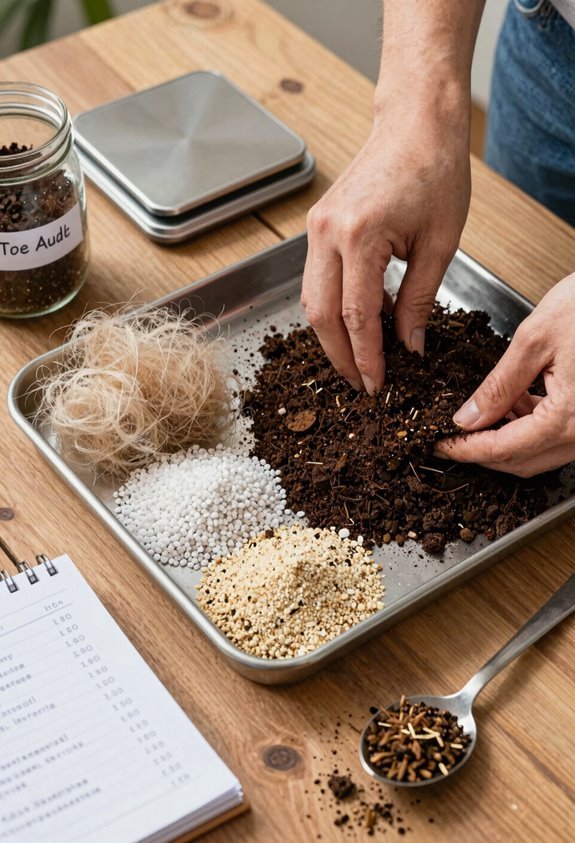
So which base do I start with? Your choice of base substrate shapes everything about your potting mix. Peat moss and coir fiber both handle moisture retention and aeration, but they behave differently in your containers.
Peat moss keeps things lightweight. It holds water well and gives roots room to breathe. Expect acidity though. You’ll add about 1/4 cup lime per 6 gallons to fix pH balance. Coir fiber runs closer to neutral pH. It needs less adjustment. The bricks expand when wet. Source matters for salt content.
Sustainability favors coir. Peat harvests slower than it forms. Structure lasts longer with coir. Resists breakdown over seasons. Nutrients start higher in coir. Peat demands earlier feeding.
Match your base to your plants. Both improve drainage when blended right.
Lighten Your Mix With Perlite, Sand, or Vermiculite
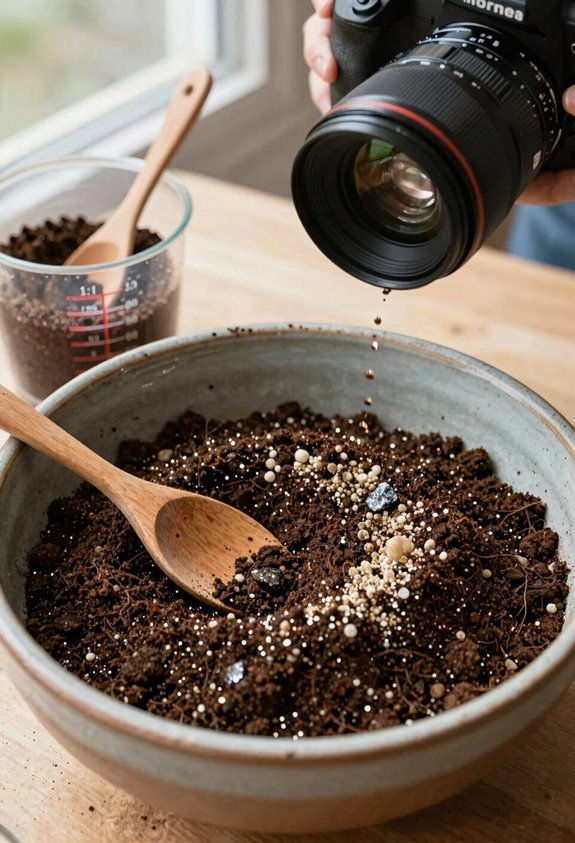
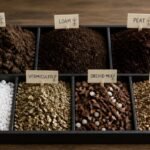
Now you need something to keep your base from getting dense. I add lightweight materials to my potting mix for better drainage and aeration. Perlite works great. It’s a heated volcanic glass that expands into porous white granules. This boosts air space.
Vermiculite also expands with heat. It adds some nutrients, plus water-holding capacity. Handle it gently. It can crush and lose its airy structure. If you can’t find vermiculite, swap in coarse sand. It gives you drainage without the fluff.
| Additive | Main Job | Key Trait |
|---|---|---|
| Perlite | Aeration | Lightweight and porous |
| Vermiculite | Water-holding capacity | Adds minor nutrients |
| Sand | Drainage | Budget backup option |
Mix one part perlite or vermiculite into your base. This keeps roots breathing. Your mix stays light. Your plants stay in good shape.
Add Lime and Fertilizer for Peat-Based Mixes
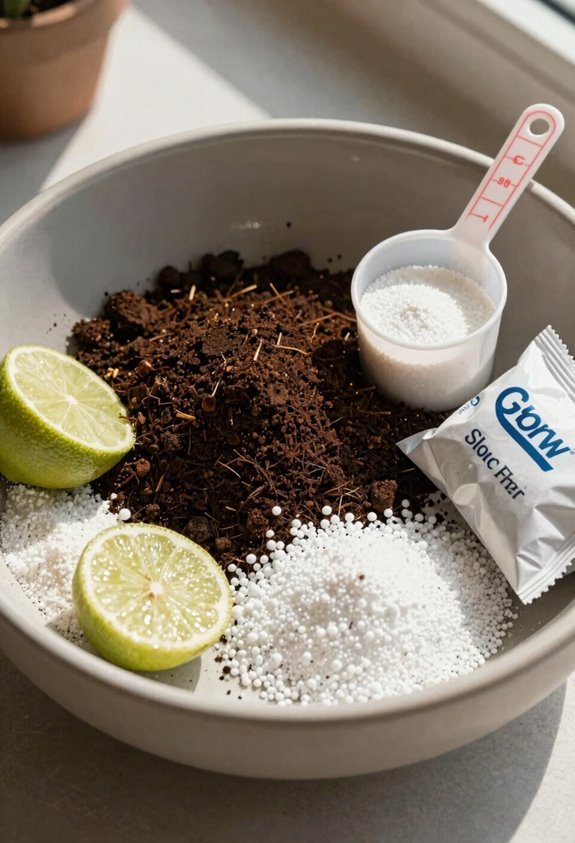
I add about 1/4 cup of dolomitic lime per 6 gallons of peat moss to push my mix toward a 6.0 to 7.0 pH window. You will want to choose a complete organic granular fertilizer like Dr. Earth or Plant-Tone and work it evenly through the peat at the labeled rate before filling any containers.
Check your pH meter once lime is mixed, as coir-heavy blends usually need less correction than straight peat.
Balancing Soil pH
Peat moss runs acidic at pH 3.5–4.5. I add limestone to my peat-based potting mix for proper pH balance. Lime raises acidity toward neutral 6.0–7.0. I use about 1/4 cup limestone per 6 gallons of peat.
Match lime to your plants. Acid-lovers like blueberries want less lime. Most ornamentals need more.
Test your mix. I grab a pH meter or kit. Stable pH beats swings that block nutrient uptake.
Add soil amendments. Bone meal, rock phosphate, and kelp meal feed the mix.
Mix in organic fertilizer. This supports nutrient availability in the adjusted range.
Know your peat. It starts low in nutrients. Lime plus amendments fixes both problems.
Essential Fertilizer Types
What does a peat-based mix need to feed plants long-term? It needs lime to fix the acidity and a blend of slow-release nutrients to sustain growth.
I add 1/4 cup of lime per 6 gallons of peat. This balances pH so roots can absorb food. For fertilizer, I build a DIY granular mix with rock phosphate, bone meal, and kelp meal. These minerals feed plants for months.
I skip compost in seed-starting blends. It is too heavy for small roots. For houseplants and general pots, I work in worm castings. I use 1/2 to 1 cup per batch. This wakes up microbes and releases nutrients. A complete organic granular fertilizer also works if you want a store-bought option.
Mixing Application Ratios
Mix 1/4 cup dolomitic lime into every 6 gallons of peat moss. This raises pH to 6.0–7.0. I’ll help you get these potting mix ratios right.
Balance the Base
Add lime to your peat-based mix. Peat runs acidic. Lime fixes that.
Build Water Retention
Use vermiculite. It holds moisture and adds calcium and magnesium.
Improve Drainage
Add perlite. It aerates the mix. Roots need air pockets to grow well.
Add Nutrients
Blend in 2 parts compost. Add vermicast if you have it.
Feed the Batch
Mix in 1 1/2 cups organic fertilizer. Include rock phosphate and kelp meal.
Combine 1 part peat with 1 part vermiculite or coarse sand. This gives structure and flow. Your pots will perform.
Customize Recipes for Seeds, Succulents, and Shrubs
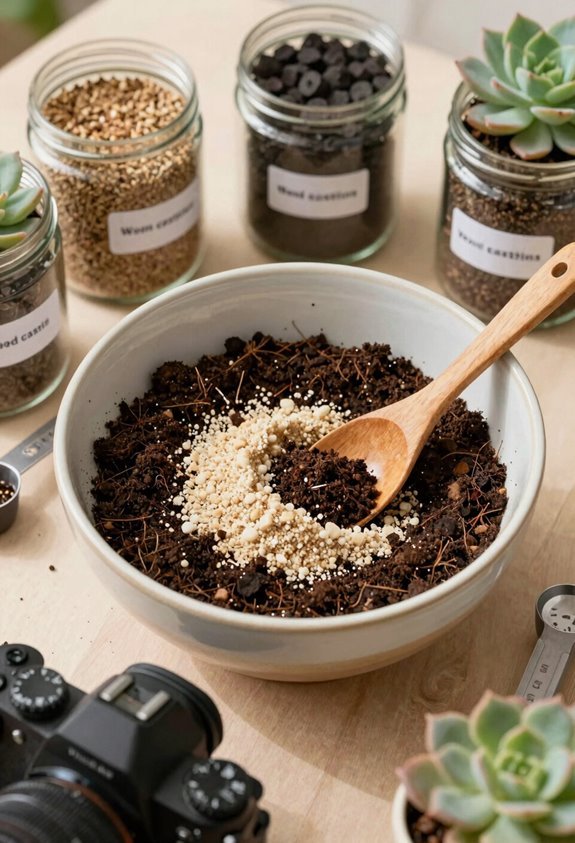
Why settle for one-size-fits-all when your plants need specific conditions? I adjust my potting mix ratios for every growing situation.
Seed-Starting Mix
I blend 2 parts peat moss, 2 parts vermiculite, and 1 part coarse sand. This gives moisture retention without waterlogging. I skip compost here to cut disease risk. For acid lovers, I add 2 to 3 tablespoons lime per 6 gallons.
Succulents and Cacti
I dial back nutrients and boost drainage. My mix runs 3 parts peat moss, 1 part perlite, and 1 part coarse sand. This prevents root rot in dry-loving plants.
Shrubs
I use 1 part peat moss, 1 part perlite, and 2 parts compost. This balances drainage with steady nutrition for woody growth.
Store Homemade Potting Mix the Right Way
Where should you put that extra potting mix? I’ll show you how I handle potting mix storage so nothing goes to waste.
Sealed containers: I store mine in sealed containers or heavy-duty plastic bags. This blocks air exposure and protects moisture retention.
Cool dry place: I keep batches in a cool dry place, away from windows. Heat breaks down organic matter fast.
Label ingredients: I label ingredients, mix type, and date on every container. No guessing later.
Shelf life: I watch shelf life closely. Homemade blends can grow bacteria if they sit too long.
Batch rotation: I use smaller bags for batch rotation. This cuts air exposure each time I dip in.
Fresh mix means healthy plants. Store it right, and you’re always ready to repot.