
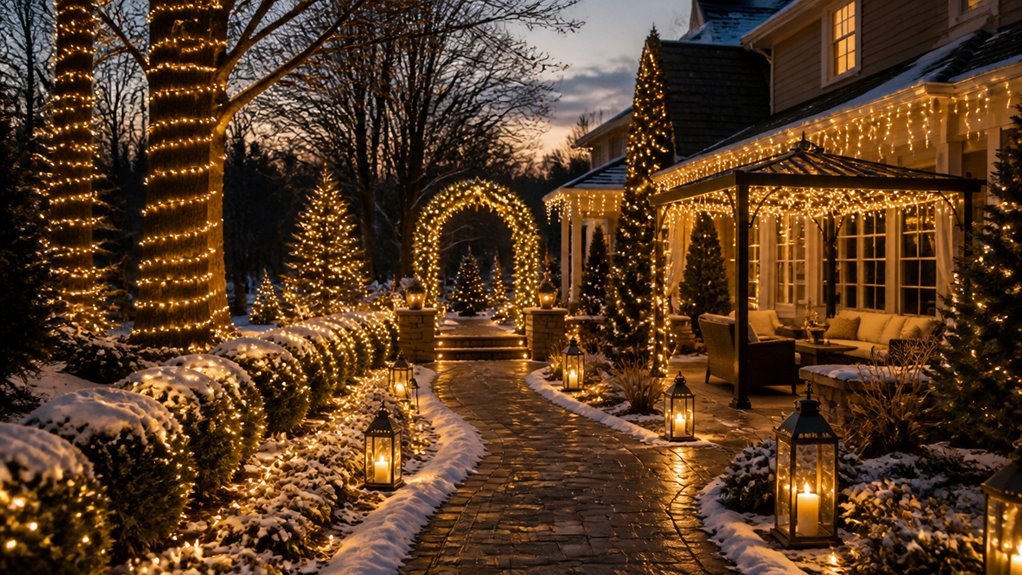
7 Outdoor Xmas Lighting Ideas to Transform Your Yard
*Home Improvement Writer*
Last December my neighbor mapped his roofline with 200 C9 bulbs spaced 12 inches apart along 150 feet of fascia. He layered warm 2700K lights on his porch columns against cool 5000K nets on his shrubs. I watched him calculate his load at 7.2 amps on a 15-amp circuit, leaving 40% headroom for safety.
Seven techniques separate amateur displays from professional-grade holiday lighting, and most homeowners skip the first step entirely.
Map Your Exterior: Measure Roof, Trees, and Power Sources First
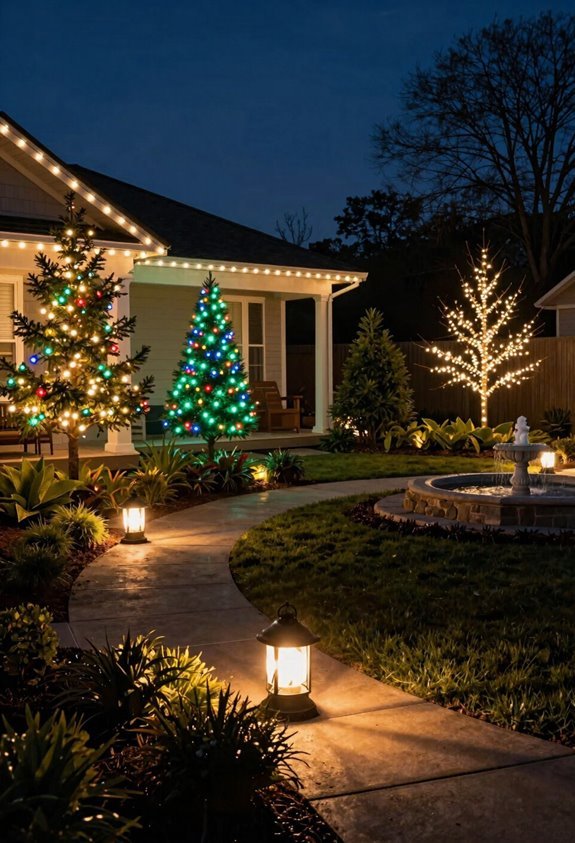
I’ll grab a tape measure and notepad first. I walk the perimeter and scan roof lines, windows, and peaks. I count each ridge and decide now: C7 bulbs for bold outlines or icicle strands for dripping effects. This shapes every choice that follows.
Measure twice, light once—roof lines demand C7 boldness or icicle drama, and that choice changes everything.
I locate exterior outlets next. I need accessible power sources for each zone. I mark distances with extension cords in mind. No one wants mid-install surprises.
I record measurements for every element. I wrap trunks and note circumferences. I pace walkways and driveways. I size bushes and porch rails. These numbers tell me exactly how many feet of lights to buy.
I pair each location with a lighting type. Roof gets outline strings. Yard gets net lights or wraps. Porch gets garland accents. I write it all down. Installation day runs smooth.
Light Your Roofline: Choose and Hang Outdoor Christmas Lights
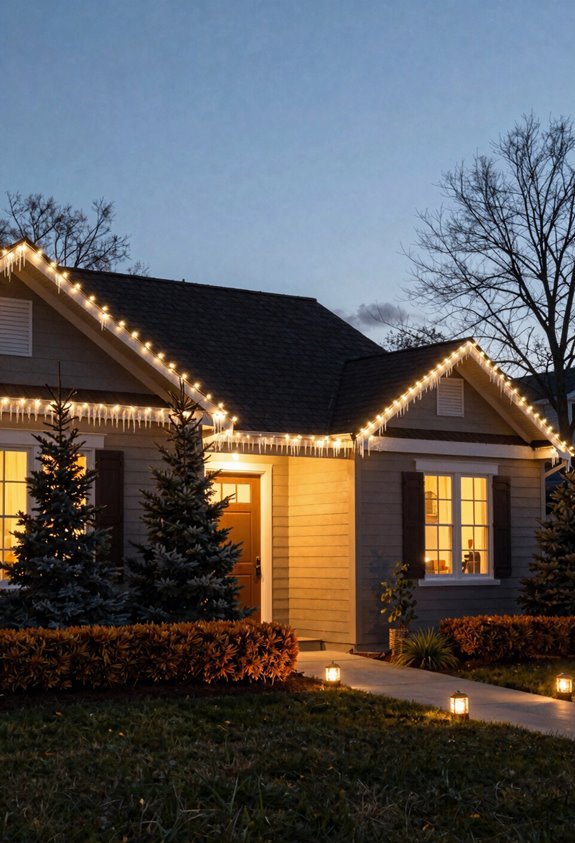
With measurements in hand, I start at the top. I select C7/C9 bulbs for my roofline outline. These larger bulbs show up from farther away. I add icicle lights to overhangs and peaks for elegance.
I consider red and white or blue and green pairings for contrast. I mix in falling rain lights for variety. I use weatherproof clips to secure everything. These clips protect my shingles and gutters.
I plan my layout before climbing. I test all strands on the ground. I work with a partner for safety. I plug into outdoor-rated outlets only. My roofline becomes the neighborhood beacon. I belong to the season now.
Wrap or Net Your Trees and Shrubs With Christmas Lights
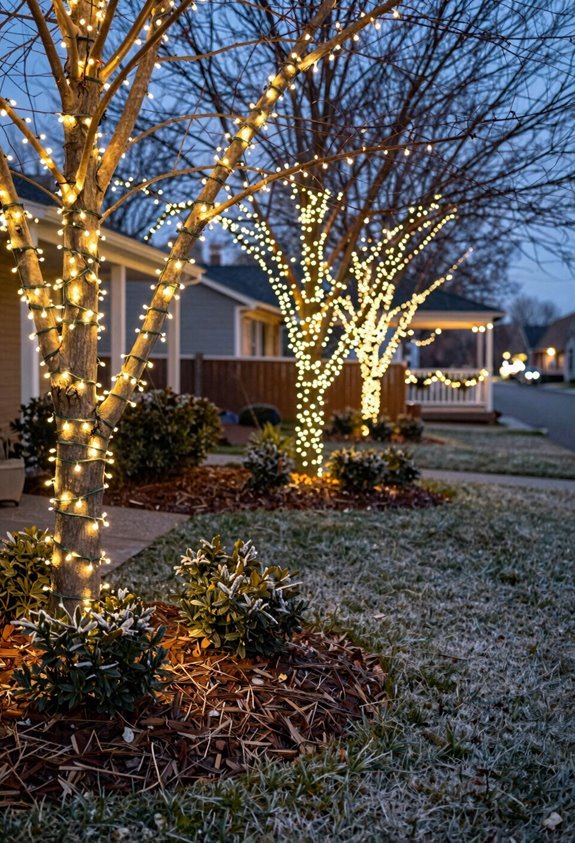
Because my trees and shrubs need structure next, I turn to wrapping and netting. I choose trunk wrap lights for speed and uniformity on large trunks. I start at the base and spiral upward to my desired wrap height. I leave slack for gaps and full coverage.
For shrubs and dense branches, I spread net lights across the surface. Net lights give even illumination without manual adjustment. I use C7 or C9 bulbs on green wire for clear visibility on evergreens. I combine trunk wrap, net lights on outer branches, and occasional inner branch wrapping. This layered approach creates cohesive glow.
I connect end plugs to power sources last.
Light Walkways and Paths for Safety and Welcome
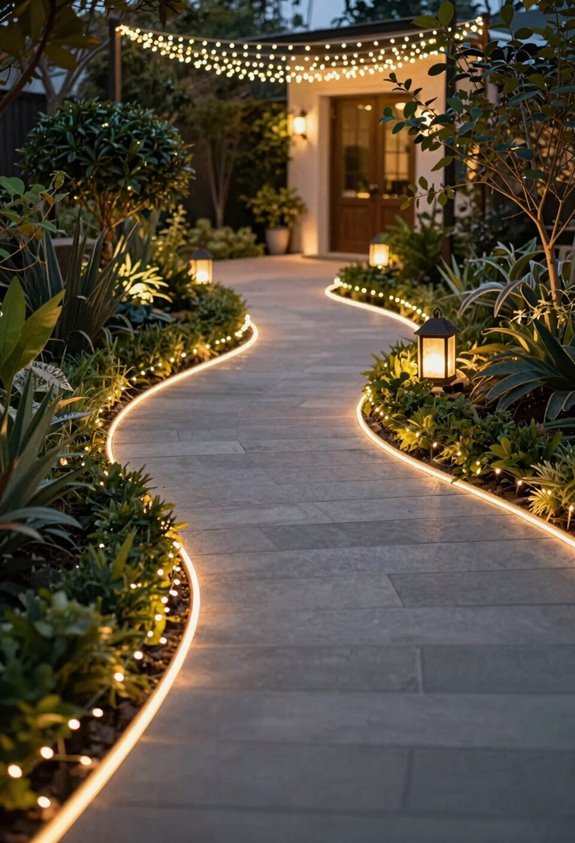
Nothing guides guests better than a well-lit path. I line my walkways with C7/C9 bulbs on green wire for clear visibility that keeps everyone steady on their feet.
Walkway Lighting Basics
C7/C9 bulbs spaced every 12 inches mark edges without guesswork. I add icicle or cascade lights for a dripping effect that catches the eye where paths turn.
Surrounding Coverage
Net lights wrap low bushes while trunk-wrap lights climb nearby trees. This frames the walk with uniform glow that feels intentional and complete.
Outdoor Safety Setup
I load circuits to 80% capacity max. Outdoor-rated extension cords and GFCI outlets prevent hazards. Smart timers or voice controls automate lights for peak hours without waste.
Layer Warm and Cool Lights for Professional Dimension
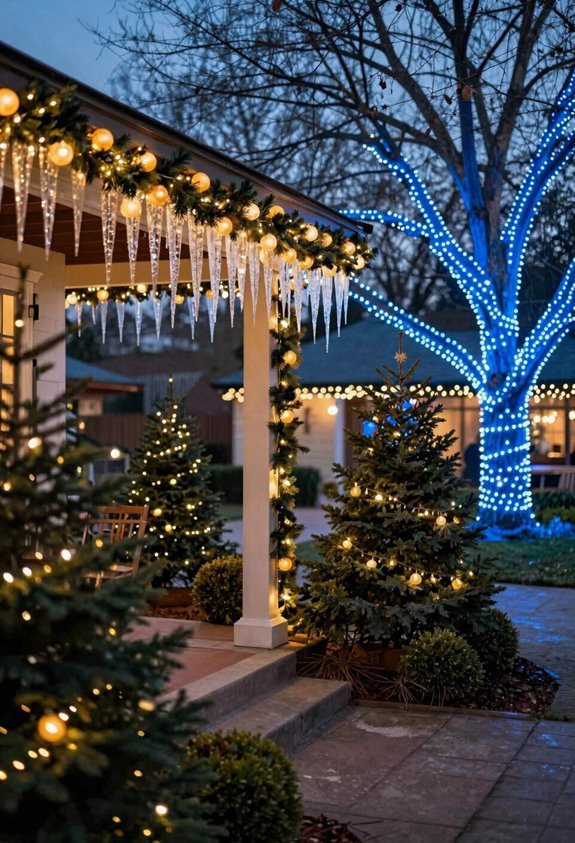
I layer warm white lights on rooflines and porches with cool white or blue lights on trees and shrubs to create contrast. I use 2700, 3000K bulbs for architectural features and 5000, 6500K bulbs for yard accents. I alternate textures like icicle lights with string lights and space groupings in odd numbers for depth.
Color Temperature Basics
Layer warm and cool lights for professional dimension. I measure color temperature in kelvin to control mood and contrast in my yard. Warm white (~2700K–3000K) wraps my entryways in coziness. Cool white (~5000K–6500K) sharpens modern edges for night drama. I choose LED fixtures for steady output and less fade over time.
Warm vs Cool White: Four Emotional Anchors
- Nostalgia: 2700K glow reminds us of childhood holidays and shared moments.
- Safety: 5000K clarity invites neighbors to walk closer and stay longer.
- Pride: Mixed temperatures show I care about craft and community standing.
- Welcome: Balanced lighting tells guests they belong here.
I pick one primary temperature for focal points. I add complementary tones to rooflines and shrubs. I space fixtures evenly to prevent hot or cold spots.
Layering Techniques Explained
Start with warm white C9 bulbs on tree trunks at 2700K. I wrap these strings close to the bark for base layering. Then I add cool white 5000K icicle lights along roof edges. This contrast separates foreground trees from background architecture.
| Layer | Placement |
|---|---|
| Warm 2700K | Tree trunks, shrubs |
| Cool 5000K | Rooflines, railings, windows |
| Mixed alternation | Walkways for depth |
I alternate color temperatures along pathways to build dimension. Warm lights on inner branches stay wrapped tight. Cooler strings hit outer edges. This layered glow creates professional depth without washing out colors.
I calculate watts per layer and split across circuits. Power stays balanced. Brightness remains consistent.
Decorate Your Porch for Maximum Curb Appeal
How do you make your porch the standout feature on your street? I start with porch lighting that frames the space with purpose. A welcoming exterior comes from clean lines and clear focal points. My outdoor display draws neighbors in without shouting.
Frame the Structure
Outline porch edges with Icicle Roof Lights or Globe/Net lights. This creates a defined border along rooflines or window casings.
Build Focal Points
Position Starlight Spheres or Starburst Lighted Branches near the porch. These catch eyes from the street.
Light the Entry
Install warm white C7 or C9 bulbs on green wire around the door. This illuminates without glare.
Layer Textures
Hang a lit wreath centered on the porch. Pair it with garlands for depth from the sidewalk view.
Calculate Power Needs: Circuits, Timers, and Smart Controls
I check my breaker panel before I hang a single bulb. I map my circuits to avoid overloading any single one. I calculate power load by adding total wattage and dividing by 120 volts for amperage. I switch to LED lights; they use 75% less energy than incandescent and let me string 40–90 sets end-to-end. I follow the 80% rule: max 1,440W on 15A circuits, 1,920W on 20A circuits for continuous outdoor use.
| Circuit Type | Max Safe Load | Typical LED Strings |
|---|---|---|
| 15A | 1,440W | 25–35 sets |
| 20A | 1,920W | 35–50 sets |
| Dedicated | Varies | Check local code |
I add timers and smart plugs to automate on/off cycles. I reduce heat buildup and trip risks. I protect my home and my display.