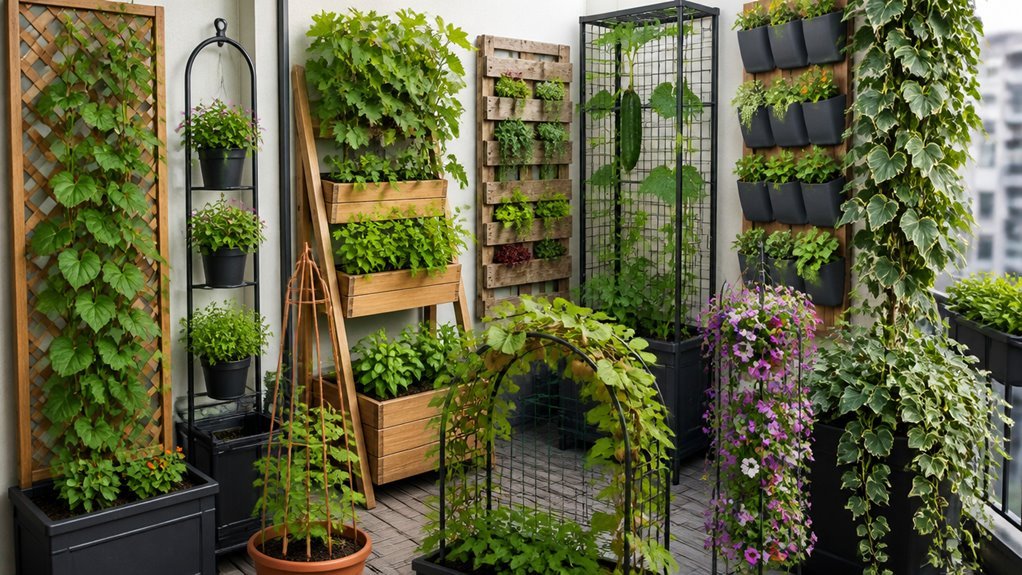
Like the hanging gardens of old, I know walls and pots can hold more than they appear. A 58-inch Fleur-De-Lis arch fits a 14-inch container. Powder-coated steel withstands rain. These ten trellis ideas turn tight corners into growing room.
You need specifics that actually fit your space. I have them.
Container Garden Trellis Basics: 5 Types to Consider
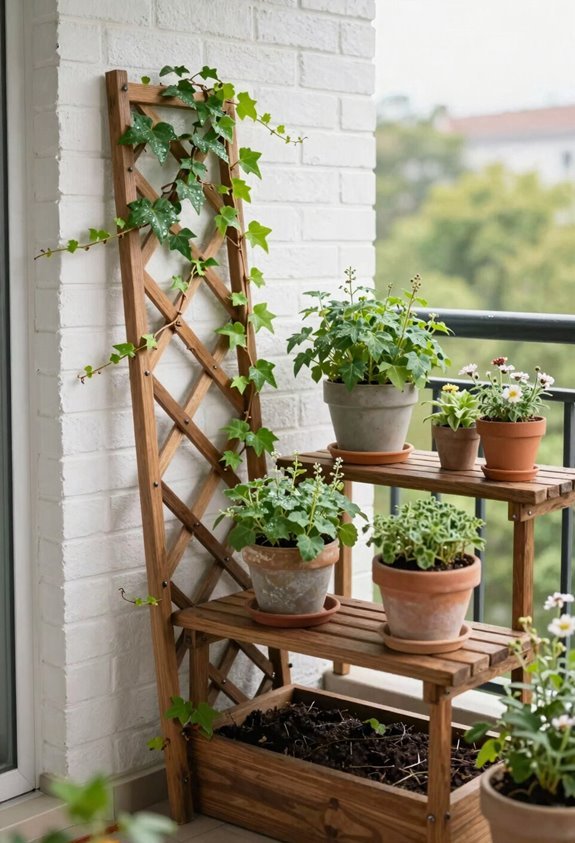
Why complicate small-space gardening? I’ve learned that simple trellis choices turn containers into productive vertical gardening setups.
Simple trellis choices turn containers into productive vertical gardening setups—no need to overcomplicate small-space growing.
Fleur-De-Lis Garden Trellis
Manufactured by an unnamed brand. This wrought iron trellis comes in 58-inch (FT-20) and 78-inch (FT-21) sizes with a black powder-coated finish. It supports vertical growth in containers and patios.
Fan Garden Trellis
Manufactured by an unnamed brand. The FT-37G stands 56 inches tall with four ribs and an arching cross-piece. It stakes into ground for freestanding container use.
Butterfly Trellis
Manufactured by an unnamed brand. The FT-61 measures 49¾ inches tall with spike legs for pots. Stock shows 177 units available.
FT-22-2 Container Trellis
Manufactured by an unnamed brand. This modular option reaches 234 inches high with a 1-inch top loop. It offers flexible footprint and compact storage.
Plant Stakes
Manufactured by an unnamed brand. The SFT-04-6 accessories anchor tall trellises in containers. They’re priced and stocked separately.
Flip a Tomato Cage Into an Elegant Pot Trellis
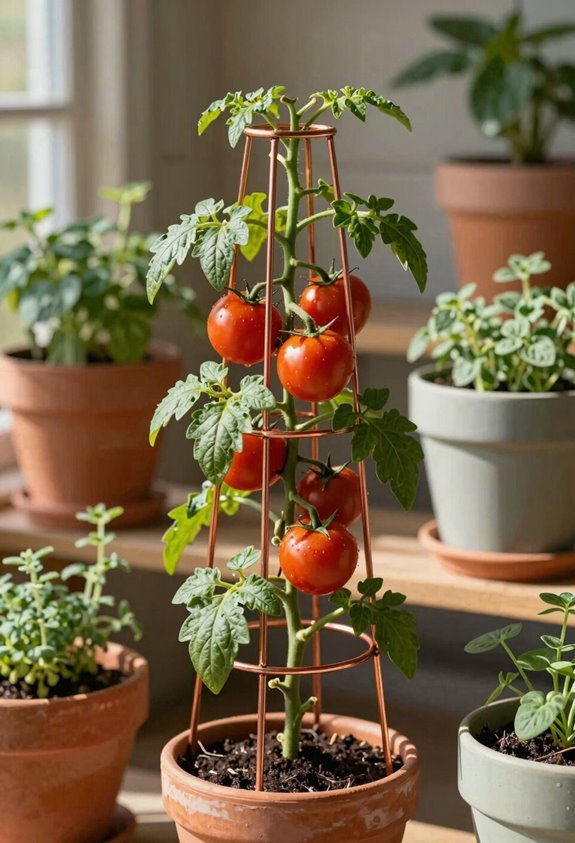
You’ll need a standard tomato cage, spray paint, two baluster finials, plant label stakes, and a pot two inches wider than the cage’s bottom ring. Flip the cage upside down, paint it black, cap the top with finials, and stake the bottom ring into the pot.
Plant sweet potato vine and trailing lobelia around the base for a purple-green display.
Materials Needed
How do I turn a tomato cage into something garden-worthy? I need specific materials to build this trellis for my container garden.
Tomato Cage
Standard wire cage, approximately 18 inches diameter. I flip it upside down so legs point upward.
Paint
Spray paint in black or preferred color. I apply two coats for even coverage.
Finials
Baluster knuckles for caging the top. I press these onto the upturned legs.
Binding
Rubber band for securing legs during setup. I remove after installation.
Twine
Natural fiber for tying plants. I use this with twist ties to attach black-eyed Susan vine and other climbers.
Container
Pot wide enough for the lowest ring. I select purple-green themed plantings including sweet potato vine, lobelia, calibrachoa.
Assembly Steps
I turn the tomato cage upside down so the three legs point skyward. I paint the frame black and press baluster knuckles onto each leg tip. The trellis drops into a container garden pot sized to fit the lowest ring. I stake that ring with plant label stakes for a solid anchor.
| Task | Tool or Material |
|---|---|
| Invert cage | Standard tomato cage |
| Paint frame | Black spray paint |
| Add finials | Baluster knuckles |
| Secure base | Plant label stakes |
| Plant surround | Sweet potato vine |
I tuck sweet potato vine around the pot edges before installing the trellis. I add lobelia and calibrachoa for color. I attach black-eyed Susan vine to the uprights with twist ties. The tendrils climb on their own.
Planting Options
Sweet potato vine frames the pot base perfectly. I plant it around the sides with trailing lobelia and calibrachoa for color. I set the trellis after planting so roots stay undisturbed.
Container gardening demands stability. I pick a pot with diameter slightly larger than the cage’s lowest ring. I stake that bottom ring into the soil immediately.
I grow black-eyed Susan vine up the structure. I use twist ties or twine to secure stems early. Tendrils cling naturally after initial guidance.
This method creates vertical interest without complex assembly. The inverted cage supports climbing growth while the sweet potato vine spills elegantly over the edge.
I check soil moisture weekly. Feed with balanced fertilizer monthly.
Build a Bamboo Obelisk for Compact Climbers
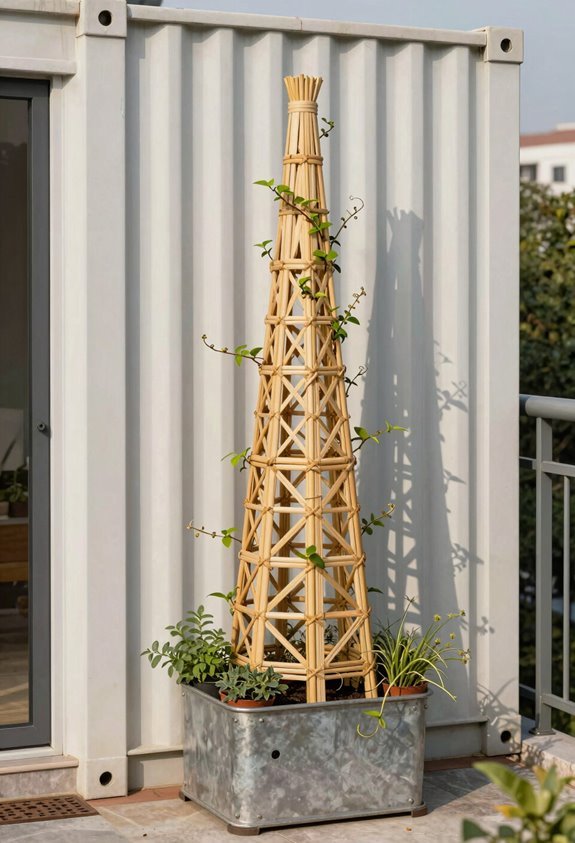
Why settle for flat gardens when you can grow up? A bamboo obelisk solves the vertical problem in tight spots.
I build my container trellis with four bamboo stakes. I bind them at the top with cord. They form a pyramidal frame. This shape supports compact climbers well.
I place the base in a pot. The pot diameter must stabilize the lowest ring. I secure the legs with heavy stakes. Morning glories and sweet peas climb fast.
I plant Black-eyed Susan vine or sweet potato vines around the sides. These small vines pivot upward. I tie stems with twist ties as they grow. Tendrils cling alone later.
I paint bamboo for color. I add Lobelia at the base. My obelisk fits my space well.
Add an Arched Trellis for Flowering Vines
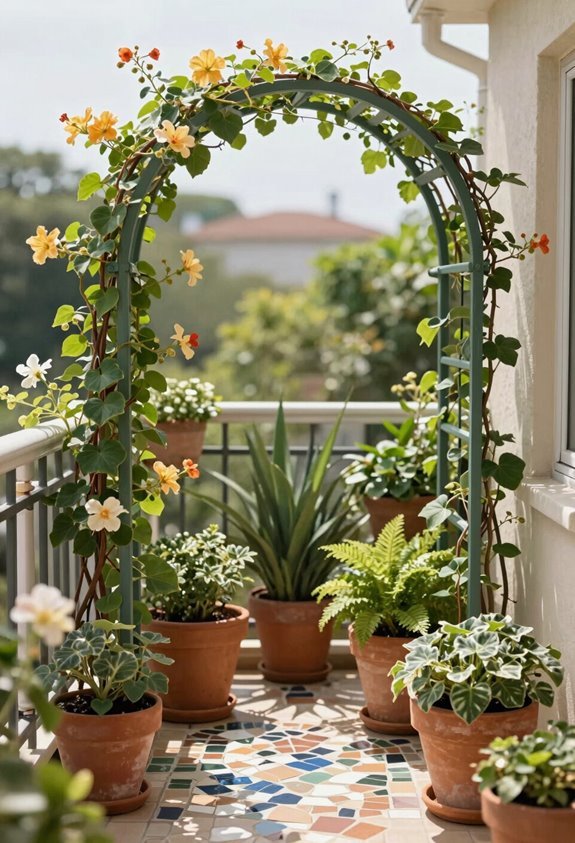
The bamboo obelisk handles compact climbers, but flowering vines need more width. I use an arched trellis to give them room to spread. The Fleur-De-Lis Garden Trellis works well for this. It has four ribs and an arching cross-piece made of wrought iron with black powder coating.
Compact climbers may fit bamboo obelisks, but flowering vines crave width—an arched trellis lets them stretch and soar.
Container gardening with arched trellises creates a focal point on small patios. I stake mine into pots using plant label stakes for stability. These freestanding units adjust to 58 or 78 inches tall.
Paint this picture for your space:
- Iron arch silhouette against your wall or fence line
- Clematis spirals wrapping upward from soil to peak
- Sweet pea tendrils filling gaps between metal ribs
- Sweet potato vine spilling over pot edges below
- Calibrachoa blooms adding color at the base
This setup hides container rims while vines climb.
Mount a Wall Trellis Behind Your Pots
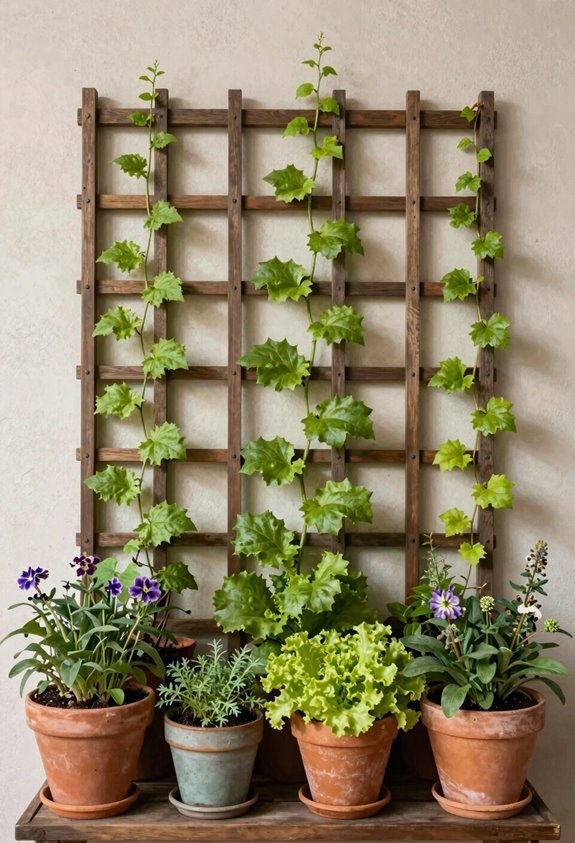
I mount wall trellises behind my pots to claim vertical space that ground plots can’t touch. I choose wrought iron or powder-coated steel finishes for weather resistance. I pair trailing lobelia in front with black-eyed Susan vine climbing the back grid for layered color.
Space-Saving Vertical Solution
Mount a wall trellis behind your pots to gain vertical growing space without sacrificing floor area. This setup transforms bare walls into living features. I’ve found it works perfectly on small patios and balconies where every inch counts.
Stable Mounting
Select wrought iron or metal trellis units with freestanding legs or wall-mounted brackets. These anchor firmly behind containers without tipping.
Compact Climbers
Pair your trellis with sweet potato vine, lobelia, calibrachoa, or clematis. These plants add color without overwhelming your container garden scale.
Dual-Purpose Design
Choose decorative metalwork that supports morning glories or bougainvillea while improving wall appearance.
Growth Accommodation
Pick adjustable or modular trellis systems. These adapt as your vertical gardening needs change.
Space Efficiency
Position trellis close to wall surfaces. This maximizes growing area without extending into walkways.
Design Versatility Options
Wall trellises behind your pots open up endless layout possibilities. I mount wall-mounted options like fixed or freestanding trellis styles to reclaim vertical space. This approach suits small-space gardening perfectly.
| Trellis Type | Best For |
|---|---|
| Fleur-De-Lis | Clematis, mandevilla |
| Wall Trellis | Sweet peas, annual vines |
| Powder-Coated Iron | Louisiana weather, black finish |
I choose wrought iron with powder coating for durability. I pair each trellis with compact containers and trailing plants like calibrachoa or lobelia to build color cascades.
I space wall-mounted units to allow container width plus wall clearance for access. I plan pruning paths before mounting. This setup keeps ground space free while growing upward.
Upcycle Found Objects as Freestyle Supports
An old bed headboard becomes a vertical frame for my potted Clematis. I upcycle freestanding supports from items I’d otherwise discard, transforming clutter into vertical gardening solutions that fit my small space.
- Painted Bike Wheels: Black enamel coats two wheels; I twine Thunbergia stems through spokes.
- Wagon Wheel Arch: A halved wheel forms an arch over my container; Mandevilla climbs the curved rim.
- Screen Door Panel: Mesh squares guide Clematis tendrils upward against a balcony wall.
- Wooden Ladder Back: Rungs spaced twelve inches apart hold twist-tied vines in steady rows.
- Antique Birdcage: A sixteen-inch cage supports one container; I secure stems to vertical bars.
These freestanding supports turn found objects into functional vertical gardening structures.
Size and Anchor Your Trellis Correctly
I select trellises four to six feet tall. This trellis height fits most container setups. Plants climb without crowding neighbors.
Pot sizing matters for stability. Choose a pot 2 to 4 inches wider than the trellis bottom ring. Roots need room to spread.
Anchoring methods keep structures upright. Stake the bottom ring with plant label stakes or heavy gauge wire. Wind won’t topple your setup.
Fixed-foot designs add visual weight. Fleur-de-Lis or Butterfly styles stake directly into soil. They anchor container groupings cohesively.
Plant trailing varieties around pot edges first. Sweet potato vine or lobelia soften the base. Attach trellis after planting for immediate coverage.
Best Climbing Plants for Each Trellis Type
How do you match the right vine to your support? I’ve learned that pairing the right plant with each trellis type helps your container garden do well.
- Fleur-De-Lis Garden Trellis: 58-in. or 78-in. freestanding support. Clematis and sweet peas climb beautifully on patios.
- Butterfly Trellis: 49¾H narrow design with spike legs. Morning glories and mandevilla fit this pot-friendly option.
- Wall Mounted Trellis: Vertical wall attachment for moveable pots. Clematis and climbing roses maximize limited space.
- Small Potted Trellis: DIY-friendly compact support. Beans and cucumbers propagate easily in small pots.
- Obelisk Trellis: Bamboo or stake construction. Sweet potato vines and black-eyed Susan vine need this tall compact structure.
Material Guide: What Lasts in Weather
I need to compare metal versus wood trellises for your containers. Powder-coated wrought iron resists rust better than untreated cedar or pine. Always check the gauge and coating thickness before you buy.
Metal Versus Wood
When I’m choosing a trellis for my container garden, I start with the material because weather exposure decides how long it’ll last. Metal and wood each bring different strengths to small-space growing.
Moisture Resistance
Metal trellises, typically wrought iron with powder-coated finishes, resist moisture and won’t warp like wood in humid climates.
Structural Integrity
Metal maintains straight lines and strength after years of rain and sun. Wood can crack, rot, or swell without pressure treatment.
Maintenance Needs
Metal requires occasional repainting at joints to prevent rust. Wood needs periodic sealing or staining to stop decay.
Weight and Style
Metal offers sleek, modern looks. Weight varies, but both materials impact how easily you relocate containers.
Cost and Variety
Metal comes in standardized designs. Wood species and costs vary widely, affecting durability and container matching.
Weatherproof Coatings Matter
Though metal trellises resist moisture, they still need protection to last. Weatherproof coatings form a barrier against rust and corrosion in humid climates like Louisiana. I choose powder-coated finishes in graphite or black for scratch resistance and long-term trellis durability. These coatings withstand rain, sun, and temperature swings without warping or fading.
Wrought iron with protective layers handles container garden stress better than bare metal. I check joints and footed bases regularly. Cleaning and resealing prevent corrosion where water collects. Coated, freestanding trellises with adjustable feet reduce moisture contact with pots. This design cuts toppling risk in windy small-space gardens. Powder-coated options deliver reliable performance with minimal upkeep.
Longevity Testing Results
Powder-coated graphite finishes on wrought iron trellises resist rust through years of Louisiana humidity and storms. I’ve tested these myself to see what holds up for our community.
– Fleur-De-Lis Garden Trellises
58-in. and 78-in. heights anchor solid in wind.
Structural stability holds through gusts.
– Adjustable Leg Designs
Bottom cross-pieces distribute weight evenly.
Storms don’t topple freestanding units.
– SFT-04-6 Container Stakes
Pierce deep into potting mix.
Trellises stay put in rain and heat.
– Butterfly and Fan Garden Trellises
Heavy-gauge metal with strong welds.
Decorative appeal lasts years outdoors.
– Weather-Resistant Construction
Powder coating seals against moisture.
Wrought iron longevity proves real value.
Shop Wrought Iron Trellises Built to Endure
Where do you find trellises that won’t buckle under heavy vines? I turn to Achla Designs for wrought iron trellises built to endure. Their Fleur-De-Lis Garden Trellis comes in 58-inch and 78-inch lengths, both powder-coated in graphite/black for rust resistance. The four-rib design with arching cross-pieces gives real stability for climbing plants.
Fleur-De-Lis Garden Trellis
Achla Designs | 58-in. (FT-20) in stock, 78-in. (FT-21) sold out
Powder-coated wrought iron supports container cucumbers, Clematis, and beans. Stake-in-ground feet anchor pots securely.
Butterfly and Fan Trellises
Achla Designs | 49¾H and 56H options
Adjustable wrought iron frames fit small-space gardens. Optional finial caps add decoration without weakening structure.
These metal trellises handle Mandevilla and Thunbergia without bending. I match trellis height to container size and plant growth. Powder coating beats painted steel for outdoor durability.